Introduction to Bitcoin
IN THIS LESSON
Understanding the Evolution of Money
Objective: Help learners understand why Bitcoin was created by exploring money’s evolution and its flaws, setting the stage for Bitcoin’s role as a decentralized solution.
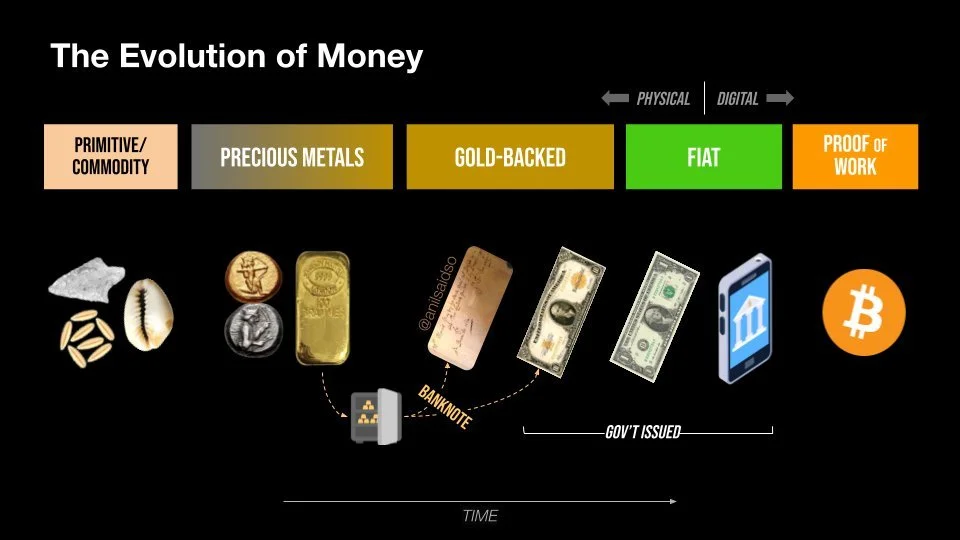
The Stages of Money Evolution
Barter System:
In ancient times, people traded goods and services directly—think swapping crops for tools. This was inefficient due to the “double coincidence of wants”: a farmer needs a baker to want his wheat for bread, which rarely aligned. Barter limited trade and economic growth, pushing societies to seek better solutions.
Commodity Money:
To solve barter’s flaws, societies adopted scarce, intrinsically valuable items like shells, livestock, or precious metals as money. Gold emerged as a favorite because it’s durable, divisible, and universally valued. Its scarcity gave it staying power, but carrying heavy coins was cumbersome, and mining couldn’t keep up with growing economies.
Gold Standard:
Governments introduced paper money backed by gold reserves, letting people trade lightweight notes redeemable for gold. This system boosted trade but relied on trust in institutions to hold enough gold. By the early 20th century, many countries began loosening this link, setting the stage for centralized control.
Fiat Money:
In the 20th century, most nations abandoned the gold standard, fully by 1971 when the US dollar cut ties with gold. Fiat money—like dollars or euros—isn’t backed by anything physical; its value depends on trust in governments and banks. This enables endless printing, leading to inflation that erodes savings and fuels debt cycles.
Added Context: Why Fiat Fails
Fiat’s lack of scarcity distorts incentives, encouraging short-term spending over saving (high time preference). It gives central banks power to manipulate money supply, often benefiting elites while everyday people lose purchasing power. For example, since 1971, the US dollar has lost over 80% of its value. This broken system sparked the need for a new kind of money.
Bitcoin as Digital Money:
Bitcoin, launched in 2009 after the 2008 financial crisis, is the next evolution. It’s a digital asset with gold-like scarcity (only 21 million coins) but easier to use, send, and store. Unlike fiat, Bitcoin is decentralized—no government or bank controls it. Unlike other cryptocurrencies, its fixed supply and robust network make it a true store of value, not speculation.
Added Context: Bitcoin’s Purpose
Bitcoin was created to restore sovereignty, letting you control your wealth without intermediaries. It’s borderless, censorship-resistant, and programmable, enabling global payments and financial freedom. For Cascais youth, it’s a tool to break free from inflation’s treadmill and build a future aligned with truth and empowerment.
Key Takeaway:
Bitcoin combines gold’s scarcity and fiat’s ease of use while removing centralized control, offering a path to financial freedom and long-term thinking in a broken monetary system.
Engagement Activity:
Reflect: How has inflation affected your life (e.g., rising costs)? Try calculating what €100 from 10 years ago buys today using an online inflation calculator. Share your thoughts in the Bitcoin Apes community!